For regular students of the early stages of the Eurovision Song Contest qualification period, there's one moment above any other that fills them with rapt anticipation - what the hell is Sasha Bognibov going to send in this year?! Every year this willowy gothic popster with a camp walk and a killer pout sends in a couple of songs to the Moldovan application process in the hope of finally being selected, but every year he sadly misses out... although when you hear his songs you might be able to understand why. (And be warned if you do venture to click on the links here, because some of them make uncomfortable listening!)
His first attempt back in 2008, the title of which we'll abreviate just so that we don't end up on any kind of register or internet watchlist, caused an immediate stir. In fact it was one of the most breathtaking debuts in Eurovision history. I Love The Girls... was a staggeringly dangerous love song to the female youth of Moldova. A wobbily, funereal techno ballad, punctuated by Sasha's ghostly falsetto, it instantly drew howls of derision from around the continent. But it's understated swing proved to be a proper earworm, and you only needed to hear it the once to have it tattooed permanantly on your internal jukebox. You just didn't want to be singing it absent-mindedly down the local Safeways.
Funnily enough it wasn't selected for the televised stages.
But that didn't put Sasha off, and the following year he had another stab with a couple more songs - the most interesting being Knocking On Julie's Heart. He even got a German friend to make a video of him strutting around the sights of Chisinau and moodily air-grabbing in ruined buildings while daubed in enough eyeliner to make The Cure blush. Julie was a slightly less controversial choice than his previous effort. A more traditional ballad with a proper arrangement and lots of angst, the boy Bognibov kept his now trademark high voice and over-annunciated English, but occasionally slipped into moments of growly goth-metal rap and even strayed occasionally into soprano territory. It was a curious oddity, but strangely likable - and certainly more accessable than his other entry that year, the more trancy but somewhat unsettling and eccentrically autotuned Fuck Me Once.
Funnily enough neither were selected for the televised stages.
For 2010's effort he went down a more sophisticated route, tapping a kind of piano bar goth swing groove with Do You Like My Sexy Lips. But despite having a hook nearly as infectious as his debut, its lyrical matter still managed to creep out music fans across the continent without them really even knowing why. While it was probably his most accessible stab at a slot on the big one, it still wasn't selected for the televised stages.
But as unsuccessful as his frequent attempts had been, he was beginning to gather a cult following. UK gossip site Popbitch has deemed him their favourite Moldovan and publish news of his every move, and the slightly more leftfield ESC fans (and yes, there is such a thing) have elevated him to almost godlike status. So the news that his relentless annual march to Eurovision ignominy had continued on to 2011 was met with much glee, and the song that he hoped would finally get him to experience his big day in the sun was strangely to revisit the themes that first brought him to our attention, albeit in a far beefier wrapper. Do You Know I Love A Girl? features for the first time some beefed up Rammstein-esque guitars and a full on band arrangement, only this time the girl in question is a year older.
Again there has been much indignation outside of Moldova about the song's subject matter, but strangely very little of the same hoo-haa back home. It could be that the customs and social politics of the country are so far removed from ours that his songs barely raise an eyebrow of dissent. Or perhaps he is too far down the musical foodchain for his countrymen to even notice he exists. But he doesn't seem to be having his windows bricked in the same way that anyone attempting such lyrics would over here. Indeed, despite some of the more unhinged sounding subject matter, there is an innocence and naivity running through his songs that make you want to grudgingly like him, despite your better judgement. He seems an intensly serious young man, so perhaps there's something in it that we just don't understand? Maybe it's intellectual beyond our ken? The product of a dark, superior humour. Or perhaps he's is just weird after all?
But this year the wider continent might just get the chance to experience his dubious concoctions. Rumour has it that the take up for this year's Moldovan Song For Europe competition is pretty low, and they're struggling to get enough half decent songs to fill up their semi-finals. So could we finally see our unlikely anti-hero on an international stage? It would certainly kick up a bit of a fuss now, wouldn't it!
The Eurovision Song Contest is an annual carnival of all that's great and not so great in the world of pop from all corners of of the continent. But every year there's a small handful of songs by acts who don't look like they should really be there. Acts that you'd listen to in the real world, who sneak into your consciousness and end up becoming firm favourites for many years to come. The 2010 incarnation of the contest was no exception, with a small clump of crackers hidden among more deliberate Europop.
But no one had a rougher ride of it this year than Russia's sublime song contest candidate Peter Nalitch.
I first came across the man at this year's Russian national final. The show itself was a splendid confection, full of dark ballads, intense Slavic pop and of course those fabulous Babushkas. But smack in the middle of a thoroughly entertaining 25 song battle came Nalitch's morbid bamboozler Lost & Forgotten.
Instantly darkening the tone with its understated bar room, almost jazz tinged folk, I almost dashed to the loo, thinking it to be a handy mid-contest wee break. But suddenly, from out of nowhere as the chorus kicked in, burst a joyful hound's howl of a backing vocal, and I abated my trip to see where this curiosity was going.
Then came the middle bit - a weird call and response interlude between the guitarist (spoken) and the fella out front (sung in a plaintive falsetto) as he stared into an unseen photograph. And it was brilliant. By the time the song had built up to its last few bars of over-emotive plod-and-roll bombast I was hooked - standing on the sofa and singing along. That's the last we'll see of that, I thought. But I was so glad that we'd been given the chance to share it.
But then, at the climax of the voting came to pass, something weird happened. It won. By a street. And the crowd were going absolutely bonkers for it. There was more to this Nalitch fella than met the eye, and I had to find it out.
It turns out that the lad himself was something of a phenomenon in his home country. The nation's first true internet celebrity, his home made clip for his song Gitar - filmed by him and a few of his mates and sung in a quaintly clunky pigeon English - had gone absolutely bonkers on YouTube, propelling him to an unexpected fame. He was also something of an all round good guy, giving away any new songs to his fans via his website long before he released them commercially. He's also broadcast live gigs onto the net from his Moscow flat via Russia's RuTube broadcasting site.
So, the kind of interesting and thoughtful act that Eurovision fans would take to their hearts, you would think. Not on your nelly. A huge swathe of them just didn't get the wry, dark humour. Rather than seeing it as an intelligent and deadpan post-modern ballad, performed in the style of a late sixties degenerate intellectual student band, they just thought it was dull. "It must be a fix!", some bleated, assuming that it was some localised version of My Lovely Horse, chosen because the Russians didn't want to hold the contest again. "It's boring and depressing!" yet more chimed - and went on to boo their every performance on the big Oslo stage - especially when it was announced that it got through to the final.
But what do they know. Those of us who were lucky enough to get into the gig Nalitch and his chums played at the Russian party in Oslo witnessed a well-rounded band with a set load of intelligently funny songs, and some teary-eyed, sing-along Moscow ballads. Anyone who's visited Russia will have heard the older breed of this kind of stuff permanently pumping out of the collective radios in any market or shopping neighbourhood. It's fabulously, entertaining, brilliantly mawkish intellectual drinking songs, and you could do worse that to head off to his site and download anything you can find.
As sure as Spring brings daffodils and little baby lambs, in some curious corners of society it also brings with it Eurovision fever. Unknown to most of you there have been a cavalcade of national finals around the continent since the crack of the year, and now, all bar the final tweaks and remixes, all 39 songs for this year's edition have been chosen.
But 2010 is a bit different. Universally accepted as the worst contest since the drab days of the mid 90s, this year sees a barrage of Disney ballads, mid-tempo plodders and Pop Idol karaoke. Even hardened Eurovision fans are admitting it all looks a bit dull. But if could have all been so different. In practically every national final (well, except ours, naturally) there was one or two stand out tunes that would have filled the contest with a little bit of joy, excitement or downright bewilderment.
So here's a brief trip through some of the best songs that never made it, and some of the freakazoid curiosities this year's line up is sadly missing. But be warned, it's for strong stomachs, so you might want to digest it all in a couple of visits. Madams et monseiurs, settle in for the Eurovision that should have been...
There may have been better national finals, but there certainly wasn't any more eventful events than the Moldova process. Over the period of a couple of months the choices of national broadcaster TRM managed to wind the population up so much with its final selections that there was protests on the streets of Chisinau.
Perennial non-qualifier Sasha Bobnibov tried his hand again with this slightly unsettling ditty...
And who wouldn't want this bonkers Halliwell-alike representing them in Oslo?...
But best of all was the man who nearly started a revolution all his own, the supermarket security guard superstar Pavel Turcu - although I'm not sure even he understood what all the fuss was about...
The Swedes have often been accused of thinking too hard about the contest, then sending the same thing every year. So what a shame they missed out on a two prime opportunities to do something just a little bit different this year.
There was the joyful Balkan hip hop option from Andra Generationen and Dogge Doggelito...
And on the other side of the coin, the understated and quietly stunning Pain of Salvation...
Hosts Norway also missed out on two amazing chances to send something a bit different from their usual schlager fare.
A reformed A1 (yes really!) must have stood a great chance of a top five finish had the good people of the Northlands deemed them worthy...
While Keep of Kalessin did what Norway do best and made a right old racket...
Lithuania are always prone to strangeness, but they surpassed their own high standards with these two beauties this year.
Gaudentas Janusas dealt us possible the oddest song of the year. Listening to the crowd's reaction we have to assume that he's either a well-known comedian out that way, or just bit unhinged...
Mariaana Seppern, on the other hand, shows that you can have all the right ingredients and still be a dozen shade of wrong. Be warned, mind, as this one is liable to stick in your brain for months...
Estonia probably had the best selection of the year, with not a single stinker among their ten tunes. This, of course, condemned whichever one of them actually got through to semi-final failure at the end of May, but that doesn't mean you can't enjoy the lot of them by clicking here. However, we rather took a shine to this pair.
Groundhog Day, and their stands-out-like-a-sore-thumb hands-in-the-air indie rock...
And the squeaky, wouldn't-want-her-round-your-house bonkersness of Iiris Vesnik...
Elsewhere around Europe, poor dear Michael Jackson still can't rest in his box - as this curious effort from Romania's Lucia Dumitrescu attests...
Malta's Glenn Vella, on the other hand, only appears to have listened to Thriller for the last 14 years...
There was also a refreshing batch of slightly rocky, punky and indiefied tunes scattered around the continent - none of which, of course, made it through to Oslo. And in most of these cases, that's a danged shame.
Croatia's Valungari offered up this gloriously singalong bit of ska-folk fusion. Nice chandelier, too...
Iceland appear to be having somewhat of a Tenpole Tudor revival. Just take a look at Hvanndalsbræður...
And whoever knew that the Greeks had so this kind of shouty bondage pop in them!...
We also loved the unlikely Albanian gloom fest of Bojken Lako and Banda Adriatica. Five and a half minutes of dark, rambling pomp, infused with weirdly folksy bits, it doesn't really get going till the last minute, but you'll be glad you sat out the journey...
Before we get on with the good stuff, I feel compelled to draw your attention to two of the worst performances I've ever seen in 40 odd years of following this funny old contest.
Constantinos Kontozis and Soul Throw obviously thought they were being kooky and fun, but they managed to have clutched at every 'I'm mad, me' straw in the barn of desperation, and nipped round to Nicosia central casting to cobble together a massive ragbag of wrong. Be warned, this is bad...
Meanwhile, closer to home, our very own Esme put in a vocal performance so poor you won't even feel sorry for her. What are the words again, love?...
Don't worry, we're on the home straight now. The real joy of Eurovision for the rank and file Saturday Night TV viewer is the freakazoid entries - the ones that have you shouting "Did you see that?!!!" at work on Monday morning - and we certainly missed out on a fair few gems this term.
Nick Egibyan's intro clip won't prepare you for his on stage persona in this gem from Armenia...
Latvia's final was full of curiosities, but we rather enjoyed this slightly creepy teenage stalker anthem from PeR...
This happy-go-lucky little ditty from Portugal's Seis Po'Meia Duzia would have defied explaination even back in the 70s...
Slovakia's opera rock amalgam by Pavol Remenár, Klára and Liquid Error is similarly uncategorisable, but is so good it makes your face hurt...
Their alphabetical neighbours from Slovenia had a much more gran-frightening slant on things with the frankly terrifying Zadnji Taxi...
Then there were a few tunes you probably wouldn't be too embarassed to actually admit liking in the real world.
It seemed like every country in Europe had their own car boot version of Lady Gaga in the finals this year. Most of them were scraggy pub singers in frightwigs and angular shoulders, but the best of them was Poland's Anna Cyzon, who managed to get a small slice of Stefani in there too...
Serbia missed a trick with this brilliantly chaotic number from Emina Jahovic...
While ancient Spanish rave head Chimo Bayo managed to get himself disqualfied before he even got going. But this belter would have gone down a storm among the forest of ballads we've got to sit through this year...
And we mustn't forget my new favourite band, Eläkeläiset, whose vodka-fuelled Humppa is the current soundtrack to my life...
But best of the bunch was this unassuming little outfit from Russia. Their final was packed full of gems, but this one stood head and shoulders above the rest. Had this got to Oslo it would have won by an all time record score and have been talked about for many years to come. It's quite possibly the most beautiful thing that I've ever see on a stage. So ladies and gentlemen, please accept your reward for making it all this way down this sorry list of songs, the utterly fantasic Buranovskiye Babushki...
Now there are many, who when the subject of Eurovision is raised, dismiss it with a cursory "Of course it's all political." What they are touting is usually the misguided and paranoid idea that nobody votes for the UK because everyone hates us, and there's some manner of fit up among all the other countries against us. Of course, they are wrong. The only reason nobody votes for us any more is because we send lazy-assed songs firmly rooted in the Eurovision of the past. However, in some instances Eurovision can claim to be a highly politicised beast - none the least out in the Caucasus.
Case in point is this year's Armenian entry, Apricot Stone by Eva Rivas. On the outset it sounds like nothing more sinister than a nostalgic ditty about the old days, the pretagonist's mother telling her how good life would be once she'd grown up - kind of like Ke Sera Sera with a skipbeat. But a little bit of delving will uncover all manner of mischief making.
For a start, take a look at that Armenian flag up in the top right corner. See the orange band at the bottom? That's not orange, that's apricot. The colour on the flag relates to the fruit considered to be the symbol of Armenian nationality. This thing goes back centuries, with Armenian generals going into war carrying banners and effigies made in the colour of the fruit, and the country's favourite folk instrument, the duduk (the very instrument that Eva's song begins with) is made from the wood of the tree. So perhaps the song is a call out to the diaspora of up to six million Armenians scattered around the globe in order to garner a few teary-eyed votes?
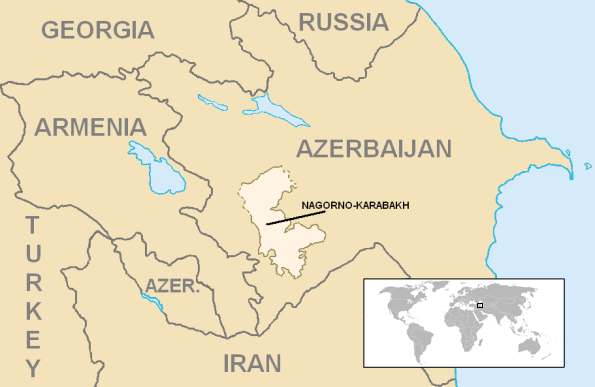
Maybe so, but some commentators are claiming yet more symbolism within the song's lyric. Some say that the mention of the fruit's stone refers to the disputed area of Nagorno-Karabakh, a predominantly Armenian enclave within the borders of Azerbaijan. These two very different nations have been niggling about this neighbourhood ever since the Russians poked their noses 90 odd years back - but would they extend their beef to something as seemingly innocent as Eurovision? You better believe it, because these two have form.
Last year the Armenians had their singer from the previous year, Shirusho, read out their scores. But look carefully and you'll notice that both on the backdrop and on the back of the very clipboard that she kept cheekily flashing at the camera was a picture of the Tatik yev Papikmomument in Nagorno-Karabakh - a symbol of Armenian nationality in that area.
Following that, it was reported that 43 Azeri residents were questioned by their Ministry of Security after it was found that they had made the very unpatriotic move of voting for Armenia in the 2009 competition in Moscow.
Obviously feelings are still running very strong between the two countries, and they're playing their local politics out in the living rooms of a hundred million viewers across the continent. And with Azerbaijan yet to choose their song in this year's contest, we suspect this one could run and run. Keep them peeled, 'cos that Saturday night at the end of May could prove to hold more political intrigue than the casual viewer could ever imagine!
As a country that suffered the ravages of dictatorship for so long, it's nice to see the Spanish take to democracy so heartily - and nowhere is it more evident than their Eurovision selection process.
Three years ago, fed up with a string of poor to middling results, some genius at RTVE had the brainwave of opening their pre-selection contest up to the masses and not only allowing anyone to enter, but giving the whole world the opportunity to vote on them. No filtering or fine tuning - anyone could enter, from the most professional record-company endorsed act to the most lowly bedroom artist. Now that's the kind of democracy I like!
So they put out a call for songers across the land to display their wares on MySpace, not realising the mild controversy that would ensue. The plan was that punters would vote for their faves, and the top few would battle it out in a televised final. All very good, but it didn't take into account that fabulous human instinct for making things cheekily difficult. Inside days an unlikely contender raced to the top of the vote table. Antonio 'El Gato' González was an elderly man who had his croaky homespun warblings set to a bizarre mininal techno backing track for the song La Bicicletera. It was racing away into a huge lead when someone at the Spanish TV station noticed that a bulk its votes all came from the same few IP addresses. It subesquently had around 100,000 votes taken away from it, but still finished respectably well up the table.
This may have been good news for those hoping for a more traditional song, but their previous fears were soon doubled by one Rodolfo Chikilicuatre with his faux reggaeton stomper Baila el Chiki-Chiki. Chikilicuatre (local slang for good for nothing), was the comic creation of comedian David Fernández, a regular cast member on rival TV station LaSexta's late night show Buenafuente. With plenty of free publicity, and a groundswell of populist funtime opinion behind it, the song walked the final, and finished in 16th in Belgrade - still one of Spain's best results in some years.
The following year RTVE tried it all again, only this time in a much more complicated way. Once again, songs were submitted via MySpace. Of the 978 entries, only 455 were considered to be within the rule. These songs were then divided into genres. The top 5 songs in each of the ten categories then qualified for a protracted series of auditions and ever decreasing heats. Runaway leaders throughout the contest were a flamenco dance act called Melody y Los Vivancos with their difficult but exciting song Amante de la Luna. But despite tieing for the lead in the final with the severe-haired songstress Soraya and her more traditionally-Eurovision flavoured dance piece La Noche es Para Mí, they missed out on a trip to Moscow on a countback technicality.
Soraya eventually came 23rd out of 25th in the final.
So bless RTVE for their persistence - they're trying the whole thing again this year. Thankfully though the process is much simpler. This time, 480 songs were submitted, of which 319 were banged up onto the TV channel's website for a straight open vote - the top ten going on to fight out a gala final. But there was immediate controversy. Each viewer to the site could vote up to five times a day from the same email address. This led to accusations that those artists signed to big labels would benefit from dedicated PR departments flooding the table with votes sent from a string of specially created email addresses. But despite this, a surprise candidate flew to the top of the leaderboard inside 24 hours.
The song Soy Un Tsunami by a botox-powered old gal calling herself Pop Star Queen stormed to the head of the field. It was soon discovered though that the performer was in fact one Karmele Marchante, a presenter from another minority channel - this time TeleCinco - who wanted to pull a similar stunt to old Chiki Chiki two years before. Close checks were then made on the content of all the submitted songs, which saw Pop Star Queen disqualified, along with a few other popular tunes (sadly also including the rather ace La Fiesta del Fuego by old-skool Valencian rave head Chimo Bayo). This meant that the table was now topped by Coral Segovia and her formula Disney-esque ballad En una Vida - particularly ironic as it was Coral who was beaten into second place by Rodolfo Chikilicuatre two years since.
But that isn't the end of it. It would seem that the curious forces behind Pop Star Queen are attempting to rocket another hapless hopeful to unexpected stardom. This has seen the unlikely rise to glory of a surly looking body-builder called John Cobra, with his raspy piece of bedroom business Carol. Leaping from near the bottom of the table to a solid third place in a few short days, RTVE are bound to cobble up some reason to disqualify it, but I for one hopes he makes it - if only to see how the poor soul is going to perform it live on a big stage in front of a whole bunch of people.
But it's the lower reaches of the voting table that holds the most joy. Mainly populated by transvestites and old men hammering away on guitars, there are many splendours to behold, and I highly recommend a quick visit to the official site to sample some of them yourself. If for nothing else than to sample the glorious marvel that is SuperEddy...
With a week of voting still to go, almost anything could happen. Coral Segovia will probably win it, as there's a general feeling among Eurovision fandom that it's her turn. But I suspect that there'll still be some thrills and spills along the way - particularly as our old mate El Gato has suddenly started creeping up the charts again!
I have a long held belief that the true roots of rock'n'roll don't actually lay in the blues and the older music of the Africas, but in the raucous folk stomps of Northern Europe. Listen to the early country recordings of Ralph Peer, who took to the mountains of the rural states of America in the twenties to log the sounds and music of the region. The songs he recorded of family groups and solo troubadors like The Carter Family, Jimmie Rodgers and Fiddlin' John Carson had more to do with polka sounds of the Baltic and the wassails of Northern England than any kind of chain gang spiritual. It was those old country warblers and hillbilly cats that had such an influential effect on the early pioneers of rock'n'roll who came from the same neighbourhoods, and I fancy you can trace that polka element right through the ages to the simple hectic thrash of contemporary punk rock - simple tunes slammed out in boom-chit boom-chit time at a hectic speed.
Perhaps that's why I fell in love with the Finnish Humppa kings Eläkeläiset the second I heard them. And what's not to love? Five alt rockers on the dangerous fringes of middle age hammering out high octane retreads of popular songs as they sit around a table drinking raw vodka and acting disgracefully? They got me hooked and wanting to move to Finland and pester them outside their houses right off the bat.
Starting as an off-shoot of the old Finnish noisemongers Kumukameli, they soon became popular in their own right, and have since become inexplicably stadium huge across the German speaking nations and the former Soviets. And now they're about to embark on their biggest challenge yet -The Eurovision Song Contest.
This weekend sees them try their hand in the third Finnish semi-final in a national contest they are huge favourites to win. And if they make it to Oslo in May, and settle themselves in among the more traditional balladeers and Europop monkeys, I fancy that we've got an unexpected treat in store.
Any band who bury alocohol along their tour route, leaving clues on their website as to where to find it, or who offer fridge magnets, bottle openers, hip flasks and XXXXXL t-shirts for their stouter fans among their merch list deserve the love of Europe - even if it is only for three minutes on a Saturday night in May. If they can beat their main rival, the junior tango king Amadeus in their home selection contest, I can guarantee they'll be the ones you're all talking about at work the following Monday morning!
Fame can be such a fleeting mistress, as Pavel Turcu is just beginning to realise. The last couple of weeks saw him rise from total obscurity to become Moldova's most talked about celebrity, only to have the rug pulled out from beneath him by his country's national TV broadcaster before he even fledged his popstar wings.
It started in such an unlikely fashion. TRM, the Moldovan state broadcaster, launched an open application process that allowed anyone to send in a song in the hope of becoming their country's entry for the 2010 Eurovision Song Contest. As the tunes rolled in, TRM put them all up onto their website to let the world have a look at and to gauge each artist's popularity.
Among the early adopters was our hero, a supermarket security guard from Ungheni with a gloriously innocent and optimistic tune called Imn Eurovision - a hymn about everything that is great about that funny old contest. The song was sweet enough, but it was the picture that accompanied it that started up all the fuss. Pavel cut a slightly awkward swathe in his starched, shiny suit and bog brush hair. But he also exuded a kind of home-spun charm that struck a nerve in everyone who saw it.
In days our boy had his own Facebook fansite, and his clip was getting more views than all the other songs in the contest put together. By the end of the week, parody clips and funny pics based on the unsuspecting singer were cropping up all over the web - including the inevitable Hitler/Downfall movie skit. He was rapidly becoming such a star that local TV news programmes were clamouring to interview him. At first they were slightly mocking of his limited but likable talents. But in time they too had hitched a ride onto the Turcu bandwagon.
It was all beginning to look good for Pavel. He was hot favourite among the Eurovision crowd to be chosen to represent his nation in front of 300 million viewers at the contest in Oslo this coming May. He'd even been practicing his dance moves in a fabulous (and admittedly slightly amusing) video that he'd published on his shiny new website. All that stood in his way was TRM and their final shortlist.
At the close of applications last week, some 87 songs had been entered. The telly folks had to trim that down a more managable 25 for the national final, and with the press that Pavel had been getting it was almost inevitable that he'd get through. After all, with public phone voting making up only a third of the eventual result, they could surely risk putting him in - if only to bump up the ratings.
But alas no. Instead they cut out all of the more outsider entries, and presented a list of safe and somewhat lifeless tunes. Pavel's hopes had been dashed almost before they'd begun. But in that fortnight he'd become the man that a whole country had suddenly been talking about. An innocent party in the kind of ad hoc personality cult that this old internet thing can create at the drop of a hat.
In his many TV interviews it was clear that he didn't entirely understand why all this was happening to him. So let's hope that it doesn't change the poor lad, and that he either goes back to normal as quickly as possible, or becomes a star of such magnitude that he can thumb his nose at the visionless naysayers at TRM. Good luck Pavel Turcu - we loved you!
As I travel around our funny old globe I'm constantly discovering all sorts of amazing music - fabulous regional rebendings of punk rock, hip hop, bonkers techno pop, hectic folk, doomy metal and all sorts of other amazing local business that we back home can scarcely imagine.
So how come the music that gets sold to us under the banner of World always ends up being either some drearily worthy yoghurt weaving Sting-alike, or every country's version of Peter Gabriel and not all the good stuff? You know, the music people actually enjoy.
In my own tiny little way I want to help introduce you to some of that good stuff. If you're up for it...


 Again there has been much indignation outside of Moldova about the song's subject matter, but strangely very little of the same hoo-haa back home. It could be that the customs and social politics of the country are so far removed from ours that his songs barely raise an eyebrow of dissent. Or perhaps he is too far down the musical foodchain for his countrymen to even notice he exists. But he doesn't seem to be having his windows bricked in the same way that anyone attempting such lyrics would over here. Indeed, despite some of the more unhinged sounding subject matter, there is an innocence and naivity running through his songs that make you want to grudgingly like him, despite your better judgement. He seems an intensly serious young man, so perhaps there's something in it that we just don't understand? Maybe it's intellectual beyond our ken? The product of a dark, superior humour. Or perhaps he's is just weird after all?